Lumen Energy ERP
A 14-module, AI-assisted ERP with a native field-sales app
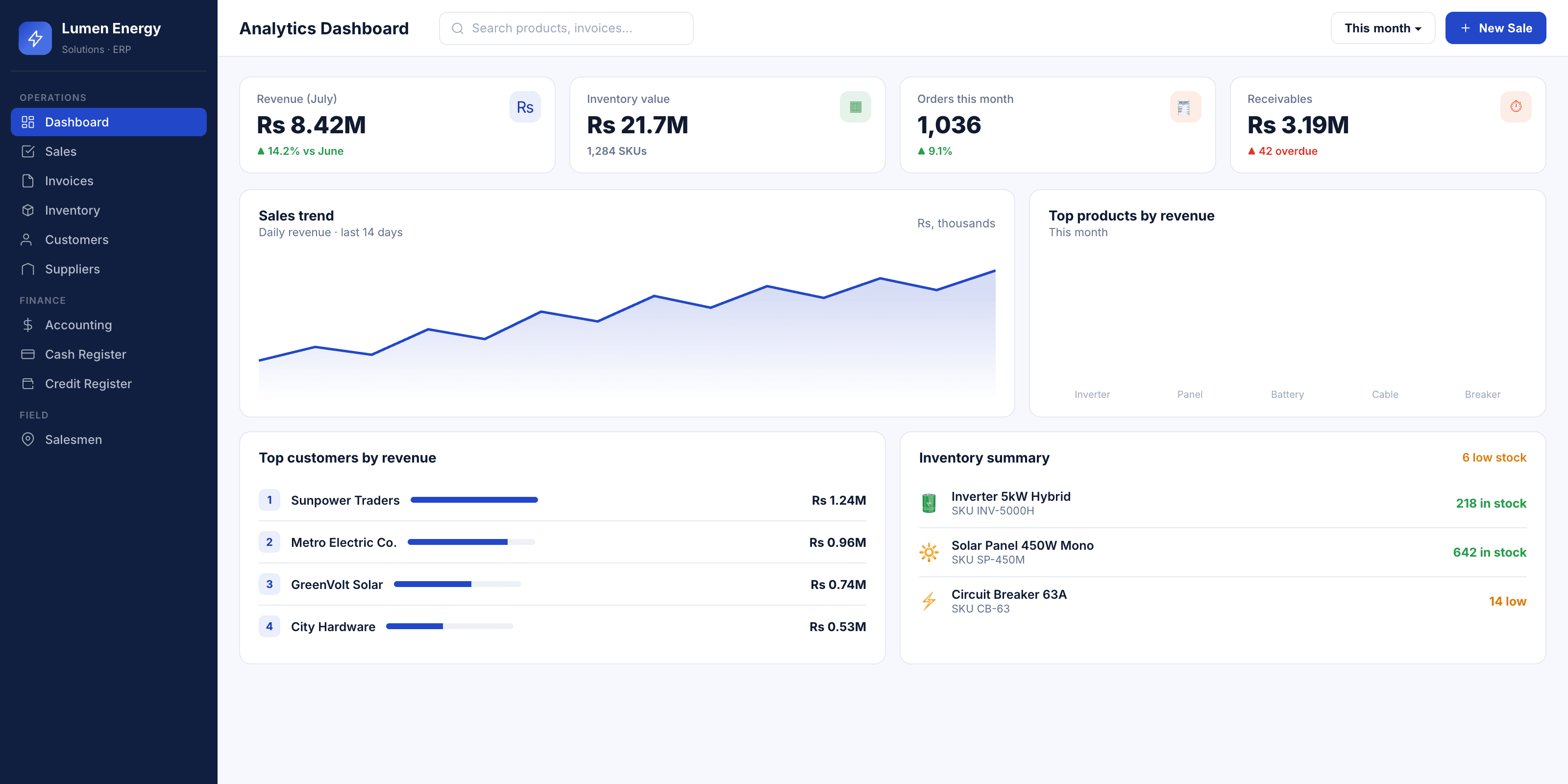
One system running inventory, sales, purchasing, POS and full double-entry accounting, with an AI layer that forecasts demand and answers questions in plain language, and a native Android app so field salesmen log orders and visits from the road.
You work directly with the engineers who wrote the code. No handoffs.
The context
Lumen Energy Solutions, an energy and electrical-equipment distributor, was running inventory, sales, purchasing and accounts through disconnected, largely manual processes. They needed a single system to run the whole business, from a POS terminal at the counter to double-entry accounts for the books, plus a way to track field salesmen who spend the day out with customers.
What we were solving
- 01
Inventory, sales, purchasing, POS and accounting lived in separate places, so nothing reconciled and no one had a live picture of the business.
- 02
Field salesmen needed real accountability: targets, commissions, and proof of customer visits, which a web back-office alone cannot capture.
- 03
The books needed proper double-entry accounting (journals, ledgers, trial balance, P&L, balance sheet), not a simple invoicing tool bolted on afterwards.
How we built it
Built a true ERP: 14 integrated modules sharing one Postgres schema and one permission model, rather than stitching together separate tools.
Modelled the real document flow explicitly, Quotation → Sales Order → Invoice → Delivery Note, with sales and purchase returns and a full accounting layer underneath every transaction.
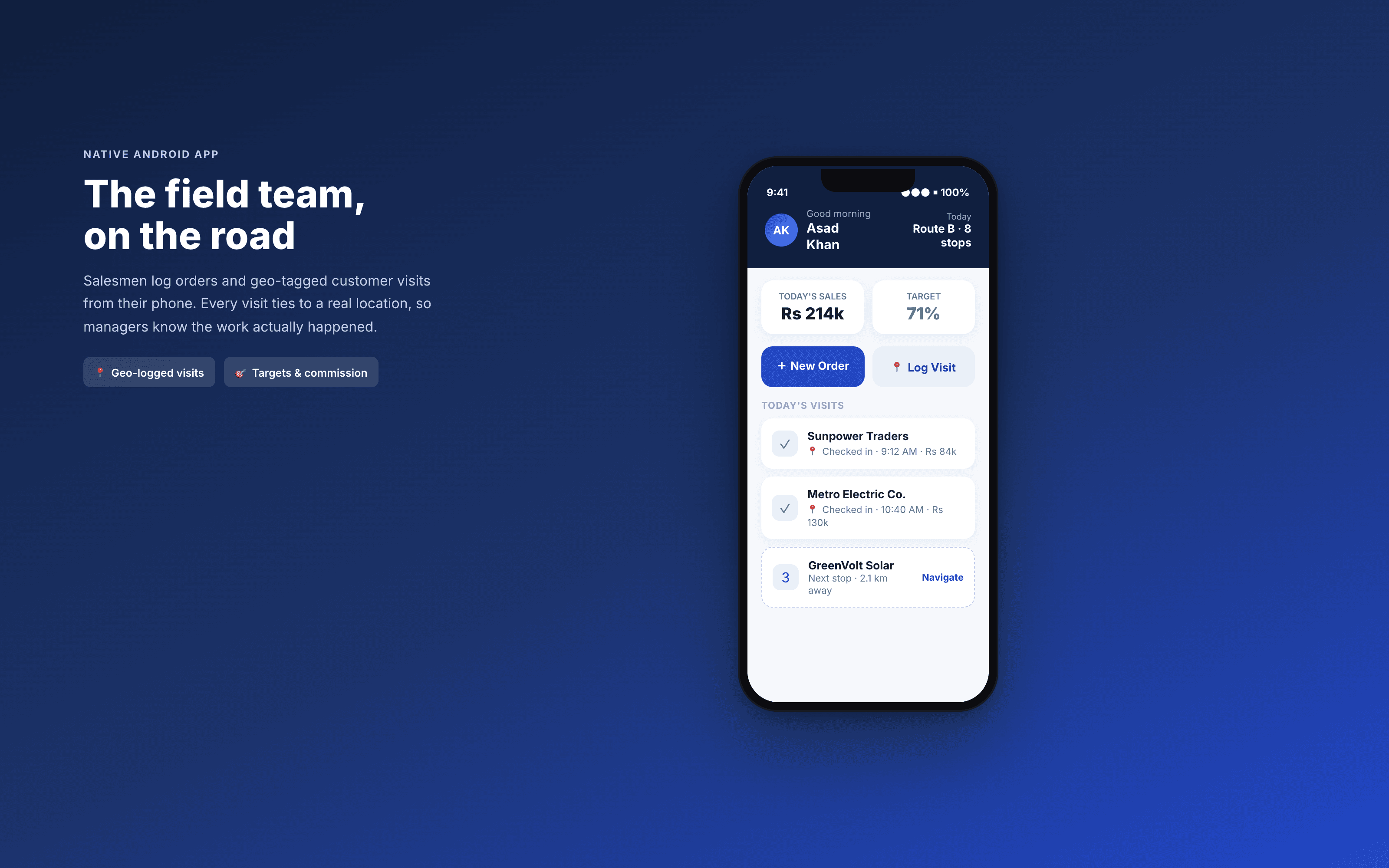
Shipped a native Android companion app just for salesmen, with a geo-logging endpoint that ties visits and orders to a location.
Packaged the whole thing as a single self-hostable service: one Coolify resource brings up Postgres and the app together and runs migrations on boot, so operational overhead stays near zero.
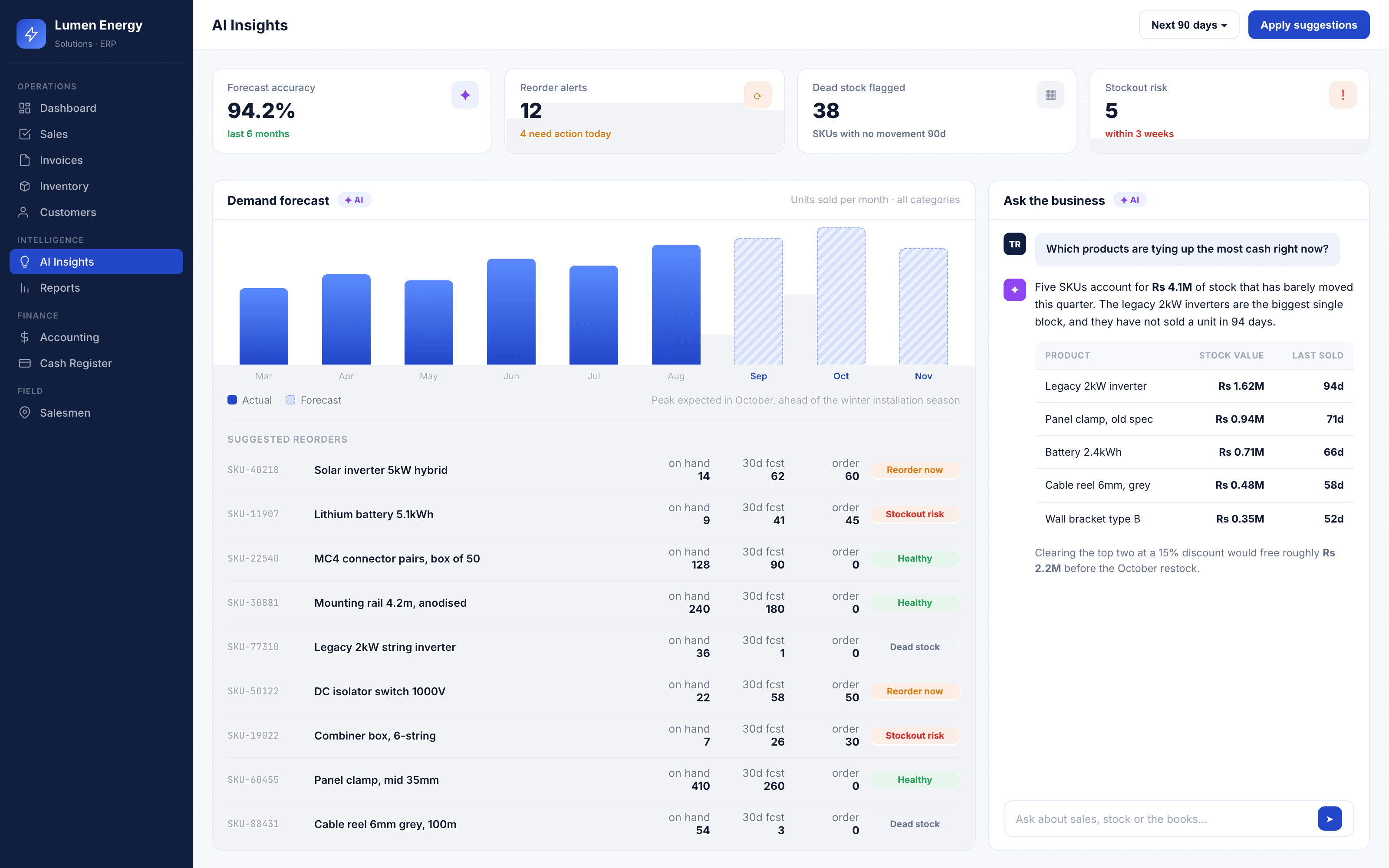
Layered AI over the shared schema: demand forecasting and reorder suggestions on inventory, natural-language reporting across the whole business, and anomaly detection on accounting entries.
Why it holds up
Inventory, sales, purchasing and accounting all read from the same records, so nothing has to be reconciled by hand after the fact.
Proper double-entry ledgers sit under every transaction, not a bolt-on invoice tool, so it holds up to an accountant's audit.
The whole system starts itself and applies its own updates, so it doesn't need a dedicated IT person babysitting it.
Visits and orders are tied to a real location, so managers know the work actually happened instead of taking it on faith.
AI reads the same live records to forecast demand and answer in plain language, so owners get insight without hunting through reports or a spreadsheet.
Reorder suggestions are based on what actually sells, so money goes into stock that moves rather than stock that sits.
Key features
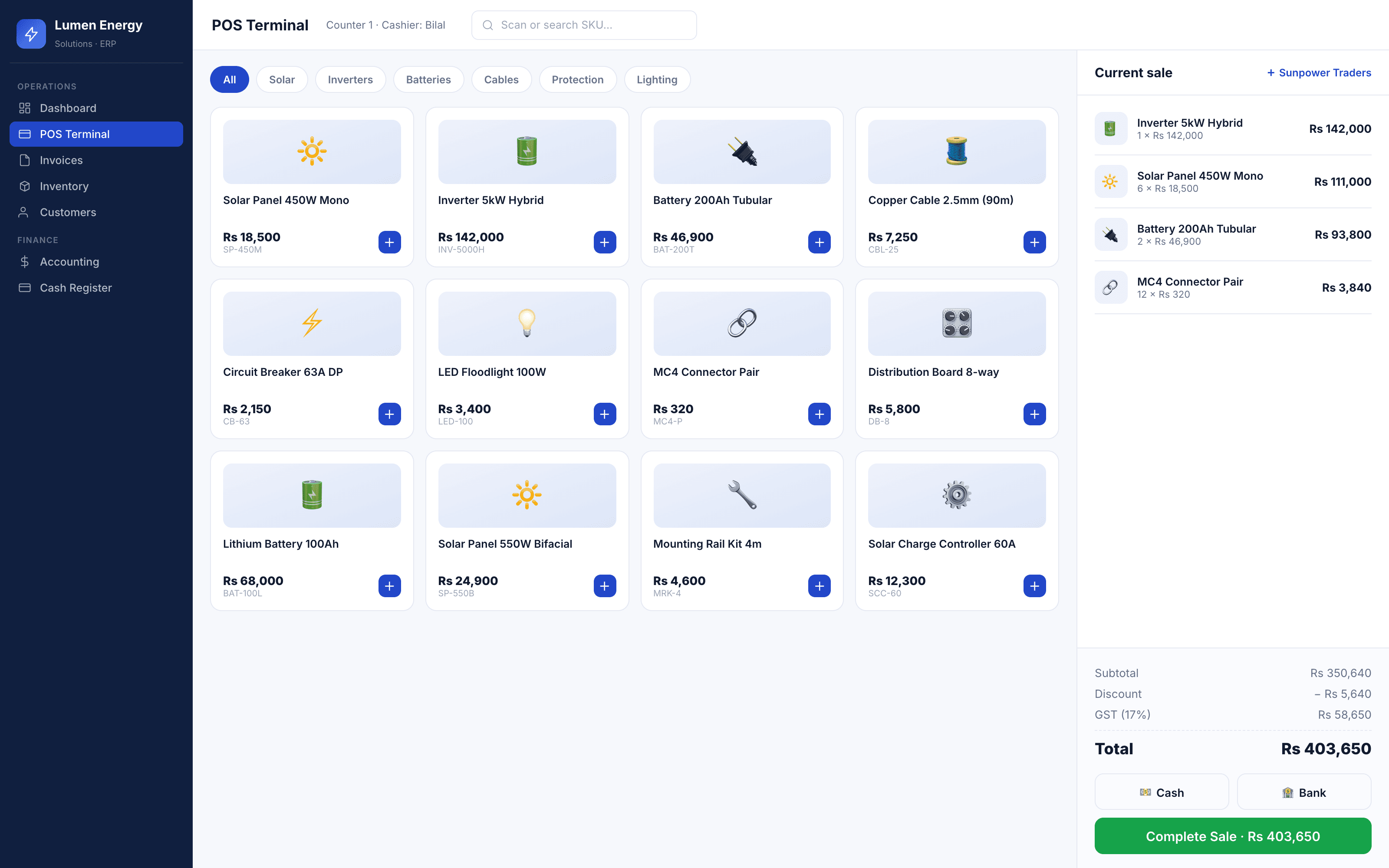
- Inventory with damaged-goods tracking, plus a full-screen POS terminal
- Quotation → Order → Invoice → Delivery → Returns document chain
- Double-entry accounting: journals, ledger, chart of accounts, trial balance, P&L, balance sheet
- Cash book, bank, credit and deposit registers
- Salesmen module: targets, commissions and geo-logged field visits via the Android app
- Approvals workflow and a system-wide audit log with old/new value diffs
- Configurable WhatsApp templates for order and customer notifications
- AI demand forecasting and inventory insights: reorder suggestions and dead-stock flags
- Natural-language reporting across sales, inventory and the books
- AI anomaly detection over accounting entries
- AI sales insights on the field app: target pacing and commission forecasting
- Public product catalog by slug, separate from the internal ERP
The outcome
Client-reported: the client told us, and we have not verified it independently. Estimate: an approximate or modelled figure. Built: what we delivered, not a result.
Two problems were quietly costing Lumen money: stock going missing between locations, and cash tied up in inventory nobody had asked for. Putting the whole operation on one set of records fixed the first, and letting AI plan reorders fixed the second, avoiding around $20,000 of stock that would have sat on a shelf. About $300,000 of inventory now moves through the system each month, with every payment, transaction and catalog entry recorded against it.
Want something like Lumen Energy ERP built?
Tell us what you are trying to ship. We build the whole stack end to end, and you work directly with the engineers writing the code, no handoffs, no juniors.
No commitment required. Response within 1 business day.