Article
Apr 4, 2026
Manual vs Automated Workflows: A Side-by-Side Cost Comparison
Automated workflows slash per-transaction costs by 77–99% compared to manual processes. 36.6% of businesses that invested in automation reported at least 25% overall cost reductions.
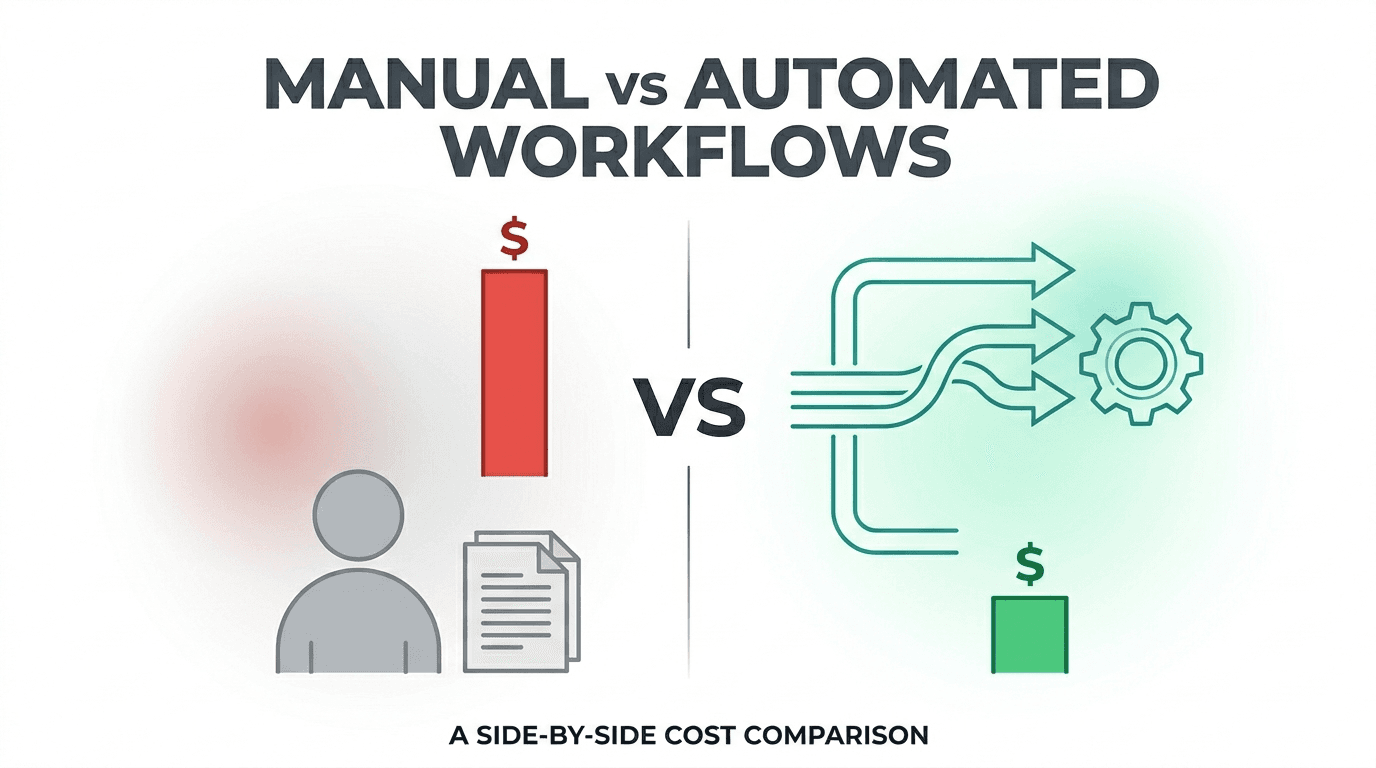
Every hour your team spends on manual data entry, payroll corrections, or customer support tickets is an hour that could be spent on something harder to replicate. According to the Redwood Software Enterprise Automation Index (2025), 73.2% of businesses increased their automation investment in the past year and 36.6% of them reported cost reductions of at least 25%. The question isn't whether automation saves money. It's whether it saves enough to justify the switch, and when.
What Are Manual Workflows and What Do They Actually Cost?
Manual workflows rely on human effort to complete repeatable tasks: entering data, processing payroll, updating inventory records, or answering customer emails. Most growing businesses start here because the entry cost is zero, so they hire people and they do the work.
But the true cost goes beyond salary. McKinsey research found that 60% of employees could save 30% of their working time if repetitive tasks were automated, simply meaning managers currently spend roughly eight hours per week on manual data work alone. At a fully-loaded cost of $35 per hour, that's $280 per manager per week consumed by tasks a script could handle in seconds.
Common Manual Workflows
Data entry and document processing
Payroll calculation and compliance checks
Inventory tracking via spreadsheets or physical counts
Customer service ticket handling and escalation routing
Software testing through manual QA review
Where Manual Workflows Make Sense
Low transaction volume: Fewer than 100 occurrences per week
High-context judgment: Relationship management, creative problem-solving
Early-stage businesses: Where cash preservation outweighs efficiency
Frequently changing processes: Automating a moving target wastes money
Where They Break Down
Error rates are high; humans make 100–400 mistakes per 10,000 data entries
They can't scale without proportional headcount increases
Hidden costs compound as volume grows
Typical Setup Cost Ranges
Simple Tools (Zapier, n8n) | Mid-Tier Platforms | Custom Built Solutions |
|---|---|---|
$50 - $300 per month | $10k - $100k Per Annum | $15k - $500k+ |
The key structural difference: automation has a high fixed cost and near-zero variable cost. Manual workflows have a low fixed cost and a variable cost that scales with every additional transaction. That gap is where automation's long-term advantage lives.
Manual vs. Automated Workflows: The Full Cost Breakdown
The clearest way to compare costs is per unit of work. Manual processes charge you per person-hour. Automated processes charge per transaction at a fraction of that rate and the gap widens as volume grows.
Workflow Type | Manual Cost | Automated Cost | Savings |
|---|---|---|---|
Document Processing | $5 - $25 | $0.10 - $0.5 | 95-98% |
Customer Support Query | $6.00 | $0.5 | 92% |
Software Test Execution | $78 | $17.54 | 77% |
Payroll Error Correction | $291 | Near 0 (prevented) | 99% |
Inventory Record Update | $2-$8 | $0.05 - $0.2 | 97% |
Sources: DocuExprt (2026) · Fullview/Gartner (2025) · Abstracta/NIST (2025) · G2/ADP (2025) · Anchor Group (2025)
Worth noting: The widest cost gaps appear in high-frequency, low-complexity tasks like document processing and customer queries where the volume multiplier makes modest per-unit savings enormous at scale. A 92% cost reduction on 10,000 monthly customer queries saves roughly $55,000 per year at the $6.00 manual cost baseline.
How Do Error Rates and Accuracy Compare?
Inaccuracy is one of the largest hidden costs in manual workflows and it's systematically underestimated. For every 10,000 data entries, humans make 100–400 errors. Automated systems produce 1–4 errors per 10,000 entries a 99th-percentile improvement in precision that compounds across every downstream process.
Payroll accuracy tells a similar story. The global payroll process mean accuracy rate without full automation is just 78%. Companies using payroll automation see 31% fewer payroll errors and 70% fewer compliance issues. Each error that slips through costs an average of $291 to remediate.
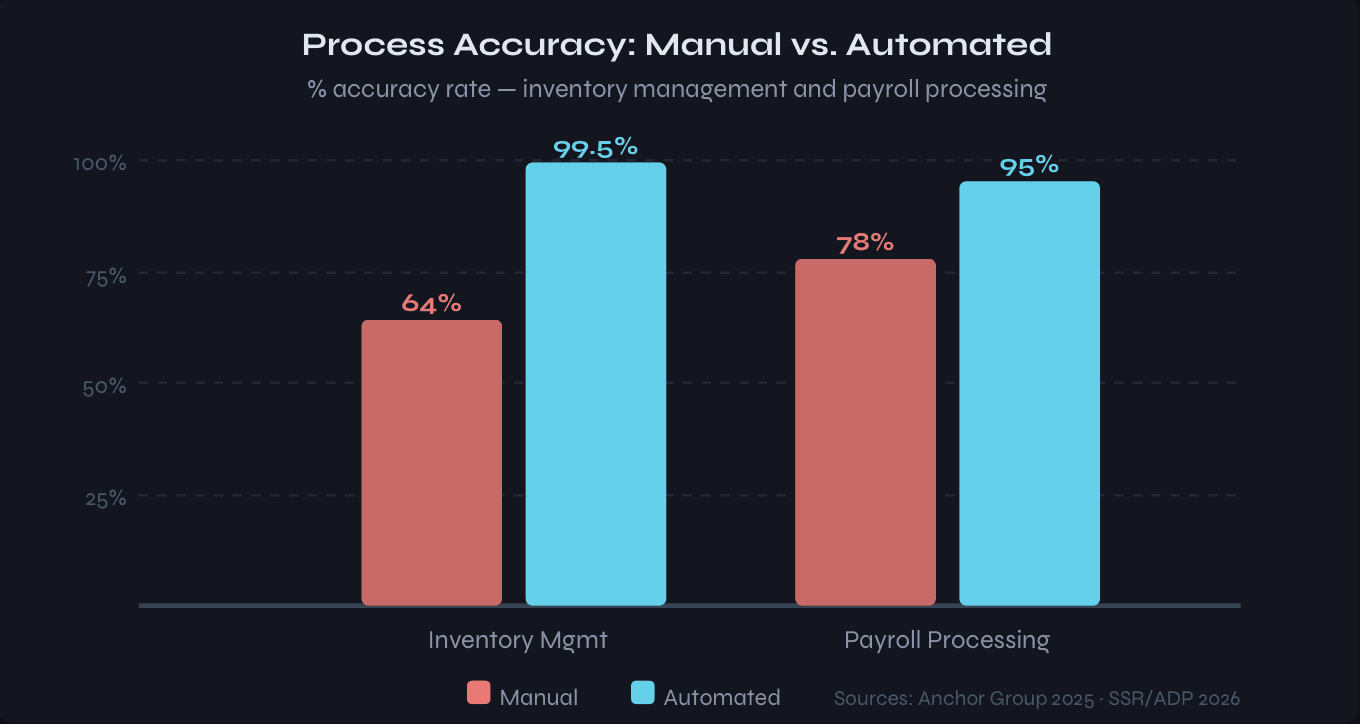
Error costs compound. A payroll error doesn't just cost $291 to fix. It triggers employee distrust, HR escalations, and potential compliance audit exposure. Automation eliminates most downstream effects, not just the direct correction cost. The $291 figure understates the true damage by a significant margin.
Industry Use Cases: Where Does Automation Pay Off Fastest?
Finance & HR: Payroll Benefits Automation
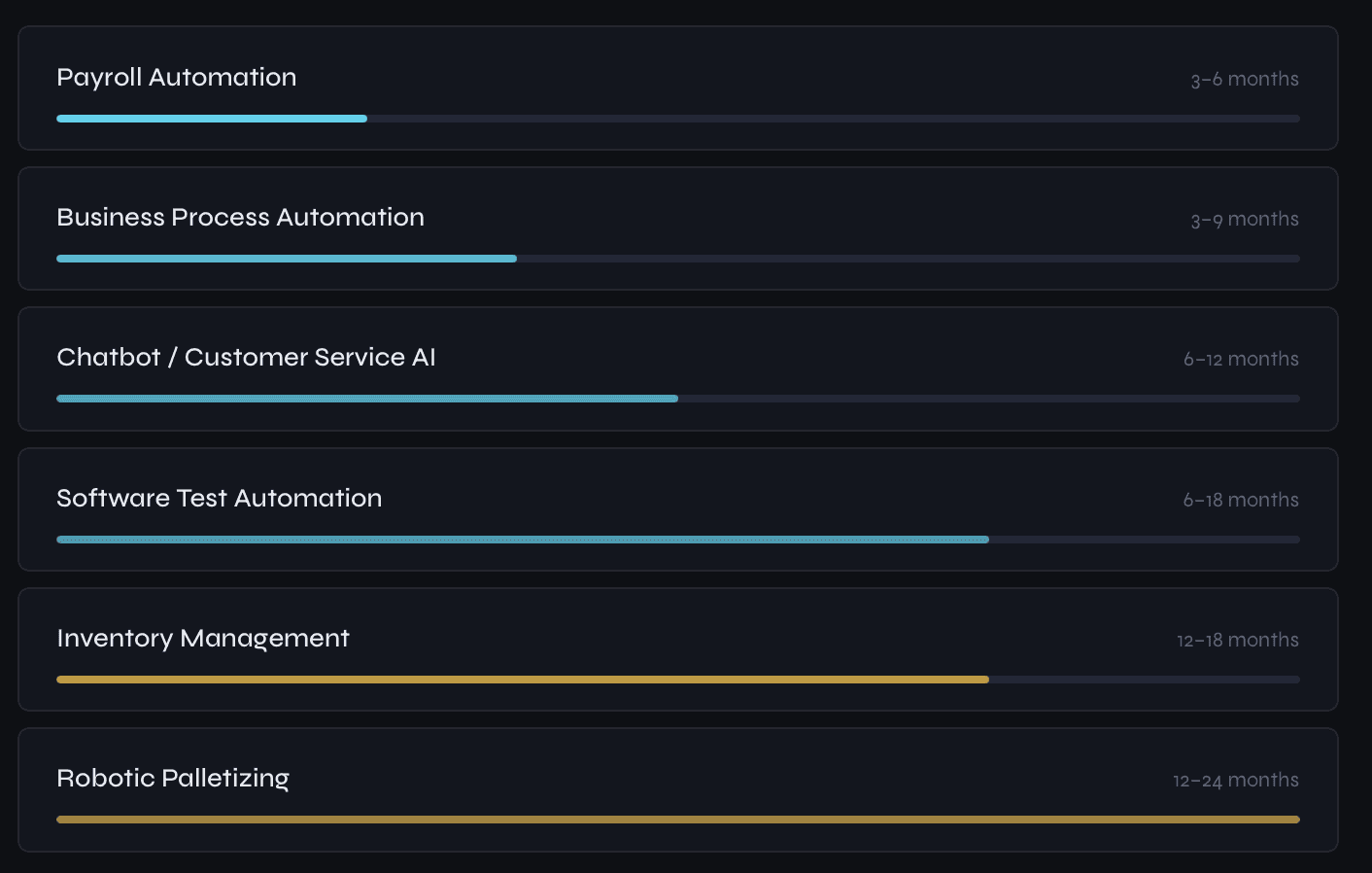
Integrated payroll systems deliver a total ROI of 131% over three years. The break-even point is typically 3–6 months for companies running payroll manually at any meaningful scale. Beyond error reduction, automated payroll systems handle tax table updates, benefits calculations, and compliance reporting, tasks that consume 8–12 hours per payroll cycle in manual environments.
231%
Total 3-year ROI from integrated payroll (ADP)
90%
Reduction in Compliance Issues
Software Development: Test Automation
Manual QA costs $78 per test execution hour. Automated testing reduces that to $17.54 — a 77% reduction per hour. Critically, defects found post-release cost five times more to fix than those caught in unit testing. Teams that automate regression testing typically see ROI within 6–18 months.
Supply Chain: Inventory & Logistics Automation
McKinsey estimates that AI integration in supply chains could reduce logistics costs by 5–20%, with manufacturers reporting up to 35% productivity gains. Automated inventory systems achieve greater than 99% accuracy versus 63–65% for manual tracking, eliminating the shrinkage, stockouts, and labor cost of manual cycle counts.
Customer Service: Chatbots vs Human Agents

AI chatbots handle up to 80% of routine inquiries at $0.10 per interaction vs. $3+ for human agents.
AI chatbots cost $0.10 per interaction. Human agents cost at least $3 a 30× difference. Gartner projects $80 billion in contact center labor savings by 2026 through conversational AI. Businesses deploying chatbots report an average of at least $50,000 in annual savings and handle up to 80% of routine inquiries without human intervention.
How Long Does It Take to Break Even on Automation?
Payback periods vary significantly by automation type. Software-based automation breaks even fastest; physical automation takes longer but delivers sustained gains.
The Hidden Costs of Manual Workflows
The obvious cost of manual processes is wages. The less obvious costs are what make the real financial case for automation.
Manual document processing costs $5–$25 per document in direct labor. But the indirect cost multiplier is $2.30–$4.70 for every $1 of direct labor; accounting for management oversight, error correction, training, turnover, and workflow delays. At that multiplier, a $10 document actually costs $33–$57 when fully loaded.
A pattern worth watching: Growing businesses consistently underestimate their manual workflow costs by 2–3× because they only count direct wages. Once you add rework, turnover, and management overhead using the $2.30–$4.70 indirect multiplier, automation ROI timelines shrink significantly sometimes by half.
How Much Time Are Manual Workflows Stealing From Your Team?
McKinsey research shows 60% of employees could save 30% of their working time by automating repetitive tasks. That savings doesn't distribute evenly.
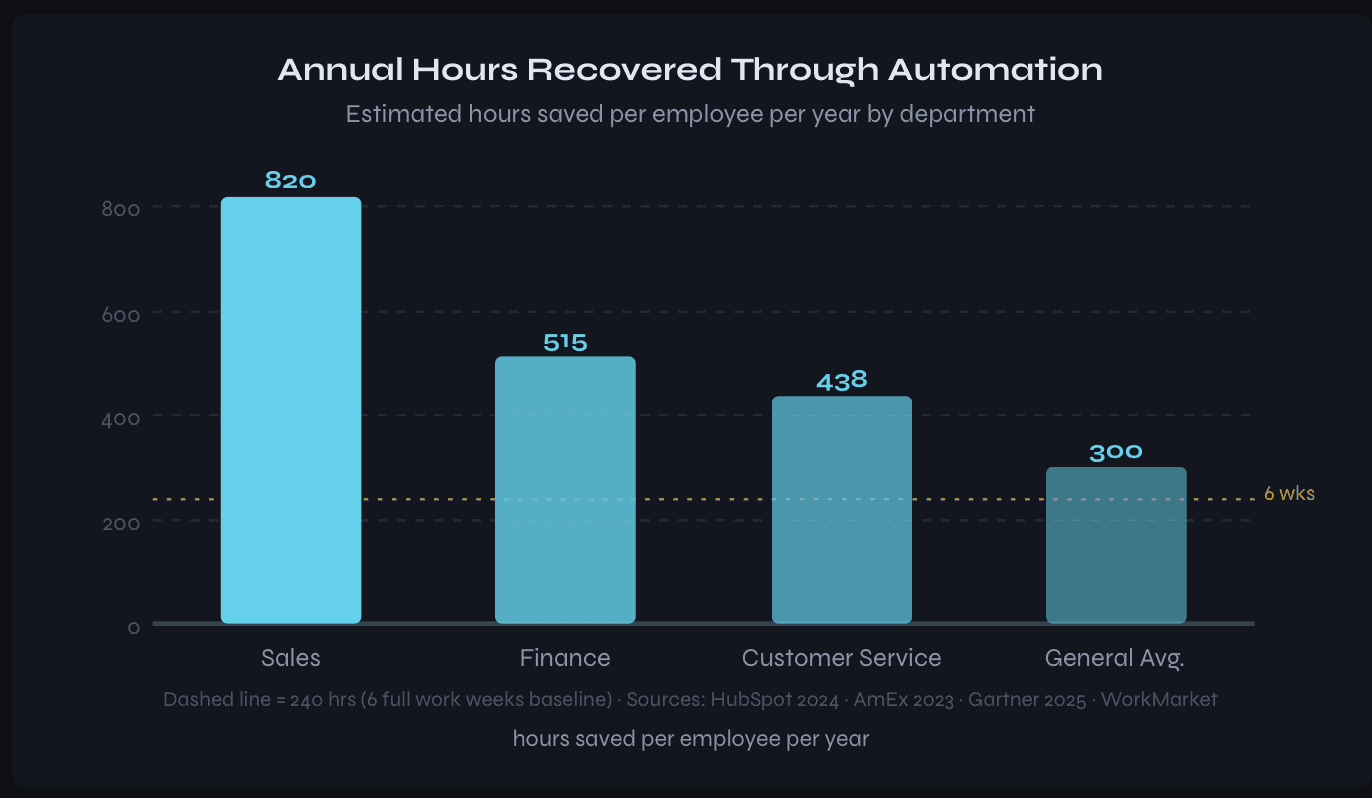
Annual hours recovered per employee through automation. The dashed line represents 6 full work weeks (240 hours) — a conservative baseline estimate.
At 300 saved hours per employee per year, a team of 20 people recovers the equivalent of roughly 1.5 full-time employees in capacity without adding to payroll. The scalability gap is where manual workflows finally break. An automated system handling 10,000 transactions costs fractionally more than it costs at 1,000, because the marginal cost per additional transaction is near zero.
When Should a Growing Business Choose Automation?
Automation isn't the right answer for every workflow. Here's a practical framework for making the call.
STAY MANUAL WHEN | AUTOMATE WHEN |
|---|---|
The task happens fewer than 50 times per week. | The same task happens more than 100 times per week. |
It requires high-context judgment or relationship management. | Errors carry material financial or compliance risk. |
Your processes are still changing frequently. | Adding customers requires proportional headcount increases. |
You're capital-constrained and the ROI timeline exceeds your planning horizon. | A proven tool already handles your specific use case. |
The Three Factor Check Before Committing
Task Volume: High-frequency tasks justify higher upfront investment. If a task happens 500 times per month at $5 each manually, you're spending $2,500/month on something a $200/month tool could handle.
Cost Per Operation: Calculate the true fully-loaded cost using the $2.30–$4.70 indirect cost multiplier, not just direct wages.
Complexity: Rule-based automation deploys fast and cheap. AI-based automation handles complexity but needs more investment and ongoing maintenance.
Frequently Asked Questions:
How much does it cost to automate business workflows?
Basic workflow automation tools start at $20–$300 per month. Mid-tier enterprise platforms run $15,000–$100,000 annually. The payback period ranges from 3–9 months most automations.
What is the error rate difference between manual and automated data entry?
Manual data entry produces 100–400 errors per 10,000 entries; an error rate of 1–4%. Automated systems produce 1–4 errors per 10,000 entries, a 100× improvement in precision. This accuracy gap directly impacts billing accuracy, compliance exposure, and downstream reporting quality.
What ROI can small businesses expect from workflow automation?
Integrated payroll systems deliver 131% total three-year ROI. Chatbot implementations typically reach 250–350% ROI as query volume grows. Inventory automation delivers 170–219% ROI over three years with payback under 18 months.
Is manual workflow management better for early-stage startups?
For businesses with low transaction volume and rapidly evolving processes, manual workflows often make more sense. Most businesses find automation starts making clear financial sense when a repeatable task occurs more than 100 times per week and the process has stabilized.
How do AI chatbots compare to human customer service agents in cost?
AI chatbots cost approximately $0.10 per customer interaction versus $3+ for a human agent which is a 30× cost difference. Chatbots handle up to 90% of routine inquiries and generate a least average $50,000 in annual savings per deployment.
Conclusion
Manual workflows are cheap to start and easy to adjust but they don't scale. Every new customer, transaction, or data point adds proportional cost, error risk, and management overhead. Automation inverts that model: high fixed cost, near-zero marginal cost, and compounding accuracy gains over time.
The numbers hold across industries. Document processing costs fall 95–98%. Customer service cost-per-interaction drops 92%. Payroll errors decline 31%, with each avoided error saving $291 in direct remediation alone. The math works, the only real question is which workflows to automate first.
Calculate fully-loaded manual cost per transaction using the $2.30–$4.70 indirect cost multiplier — not just wages
Automate first where error costs are highest or task frequency is greatest
Expect 3–6 month payback on payroll and chatbot automation; 12–24 months for physical systems
Manual workflows remain the right choice for low-volume, high-judgment tasks even in mature businesses
By: Taha Rafiq
Last Updated: Apr 4th, 2026.
Sources
Redwood Software 2025 DocuClipper 2025 G2/ADP 2025 SSR/ADP 2026 Formstack/McKinsey 2025 Fullview/Gartner 2025 Sobot 2025 Anchor Group 2025 PASCO Systems 2025 Abstracta/NIST 2025 DocuExprt 2026